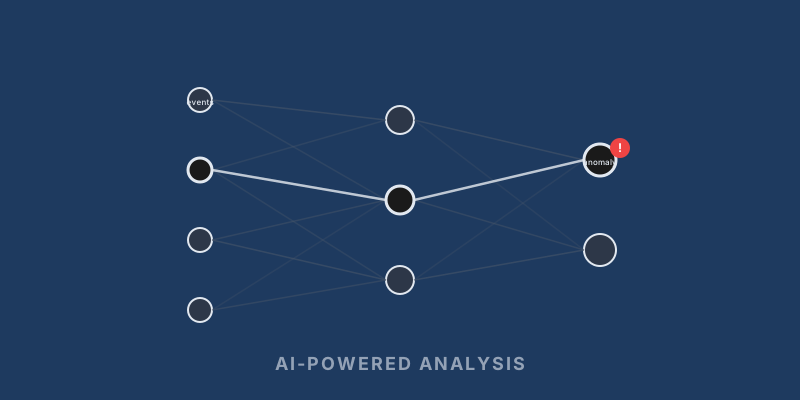
Audit logs have traditionally been a write-heavy, read-rarely system. Teams instrument events for compliance, store them for the required retention period, and only look at them when something goes wrong — usually during an incident investigation or a compliance audit.
This is a waste. Your audit logs contain a real-time signal of everything happening in your application. AI makes that signal actionable.
The Volume Problem
A mid-size B2B SaaS application with a few thousand active users can easily generate millions of audit events per month. Permission changes, document access, API calls, configuration updates — the volume adds up fast.
No human team can review this volume manually. Traditional approaches rely on static rules: alert when a user fails authentication 5 times, alert when an admin role is assigned. These rules catch known patterns but miss novel threats.
Anomaly Detection: Finding What Rules Can’t
AI-powered anomaly detection learns what “normal” looks like for your application and flags deviations. Instead of writing rules for every possible scenario, you let the model identify unusual patterns:
- A user who normally accesses 10 documents per day suddenly exports 500 in an hour.
- An admin permission change happens at 3 AM from an IP address that’s never been seen before.
- A service account starts accessing resources outside its normal scope.
These aren’t patterns you’d write rules for in advance — you might not even know they’re possible until they happen. Anomaly detection catches the unknown unknowns.
At EverScribe, anomaly detection runs continuously across your event stream. When unusual activity is detected, alerts surface in your dashboard and stream to your webhook endpoints in real time. Your security team gets signal, not noise.
Natural Language Query: Democratizing Log Access
The second AI capability that transforms audit logs is natural language querying. Today, searching audit logs requires knowing the exact field names, filter syntax, and query structure. This limits access to engineering teams.
But the people who most need audit log data — compliance officers, security analysts, legal teams — often aren’t the ones who can write structured queries.
Natural language query changes this:
- “Show me all permission changes by admin users in the last 7 days”
- “Who accessed customer data for Acme Corp this month?”
- “List all failed login attempts from outside the US”
The AI translates these into the correct structured queries, runs them, and returns results. Non-technical stakeholders get self-service access to audit data without filing tickets with engineering.
Compliance Report Generation
The third application is automated compliance reporting. During audit season, teams spend days manually compiling evidence from audit logs — pulling exports, formatting spreadsheets, cross-referencing controls.
AI can generate these reports automatically. Feed the relevant compliance framework (SOC 2 controls, HIPAA safeguards, GDPR articles) and the audit log data to an LLM, and it produces a structured report mapping your logged events to specific compliance requirements.
What used to take days becomes a single click.
From Checkbox to Competitive Advantage
The shift is fundamental. Audit logs move from a cost center (something you build because procurement demands it) to a value driver (something that actively protects your customers and differentiates your product).
Your enterprise customers don’t just want to see that you have audit logs. They want to know that unusual activity will be caught, that their compliance team can search the data independently, and that audit season won’t be a fire drill.
AI-powered audit logging is how you deliver on that promise.
EverScribe builds anomaly detection, natural language query, and compliance report generation directly into the audit logging pipeline. The same API call that ingests your events feeds the AI layer — no additional integration required.
Your audit logs are already telling a story. AI helps you hear it.